
Great Migration Safaris in Tanzania & Kenya
Tailor-made Great Migration safaris in Tanzania & Kenya, with handpicked packages and a local expert to plan every detail around where the herds are likely to be.


11-Day Uganda Birding & Gorilla Trekking Safari
12-Day Best of Kenya Wildlife Safari

7-Day Serengeti & Ngorongoro Wilderness Safari

9-Day Serengeti & Zanzibar Tanzania Safari

9-Day Treasures of Tanzania Safari
How the Great Migration actually works
The Great Wildebeest Migration isn’t a single week-long event. It’s a year-round cycle of more than a million wildebeest, zebra and antelope moving between Tanzania’s Serengeti and Kenya’s Masai Mara, following rain and new grass. When you plan a wildebeest migration safari in Tanzania and Kenya, what matters most is matching your dates to where the herds are likely to be – not to a fixed date on a map.
Our East Africa planners speak regularly with partner camps and guides in the Serengeti and Mara, so we’re working with current movement reports, not just an old diagram.
Simple timeline: where the herds usually are
These are natural patterns, not promises. When you enquire, your planner will check the latest conditions for your travel window.
Dec–Mar · Calving season in Southern Serengeti & Ndutu
Herds gather on the short-grass plains of Ndutu and Southern Serengeti to drop their calves, and predators are never far away.
- Huge concentrations of animals on open plains
- High predator activity and big photographic moments
Best matched itineraries:
- 7-Day Tanzania Great Migration Safari – Serengeti Routes
- 12-Day Gorillas, Chimps & Great Migration – Uganda & East Africa
Apr–Jun · Green season & Western/central Serengeti
As rains shift, the Migration spreads through the central Serengeti and towards the Western Corridor. Grass is lush, skies dramatic, and there are fewer vehicles than in peak months.
- Quieter game drives and better value at many camps
- Wide landscapes with herds spread out rather than tightly packed
Best matched itineraries:
- 7-Day Tanzania Great Migration Safari – Serengeti Routes
Jul–Oct · River-crossing season in Northern Serengeti & Masai Mara
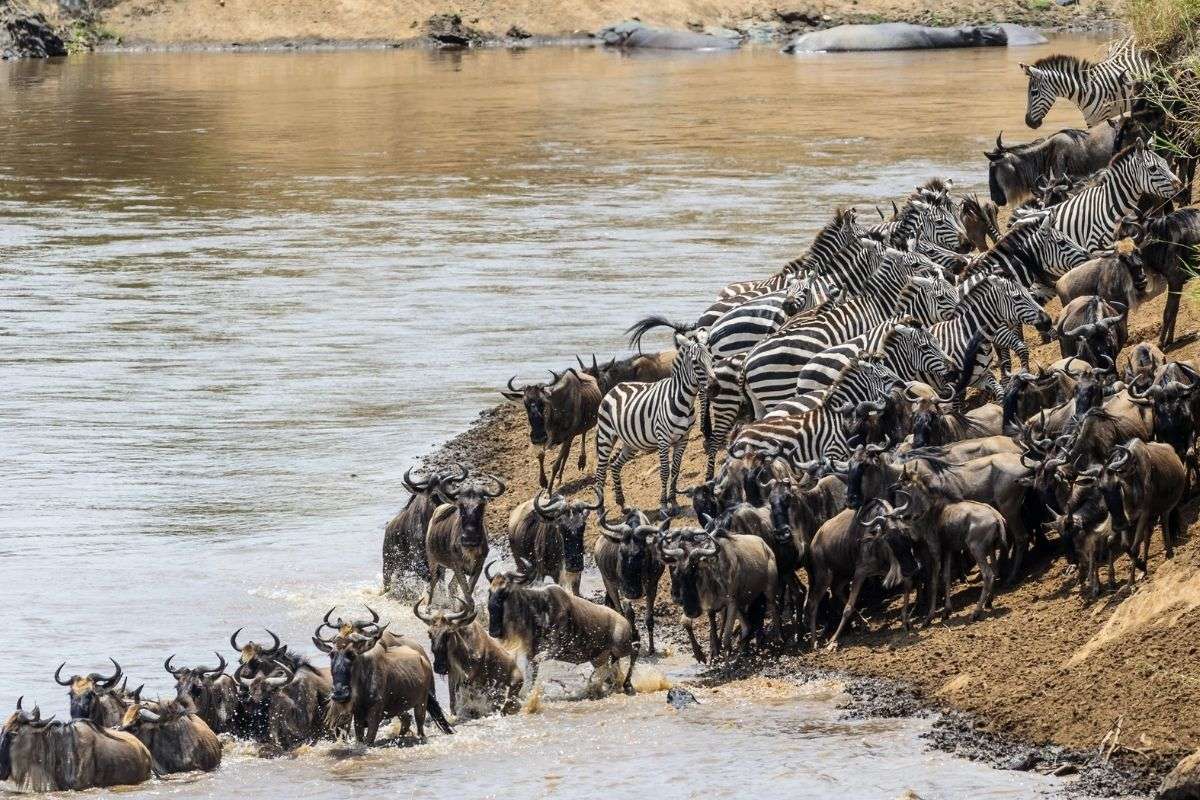
This is classic river-crossing season, when large herds often mass near the Mara and Grumeti Rivers in Northern Serengeti and the Masai Mara. It can be dramatic – and also the busiest time of year.
- Higher chance of seeing river crossings (never guaranteed)
- Huge numbers of animals, big cats and crocodiles
- Peak-season pressure in some areas; we use camp choices and private conservancies to ease the crowds
Best matched itineraries:
- 8-Day Kenya Great Migration Safari – Masai Mara & Conservancy
- 10-Day Gorillas (Uganda) & Masai Mara Migration Safari
- 12-Day Gorillas, Chimps & Great Migration – Uganda & East Africa
Travelling in this window?
Ask us whether Northern Serengeti, Masai Mara, or both make more sense for your dates
Nov · Short rains & herds moving south
With the short rains, herds begin drifting back towards the southern plains. Patterns vary year by year, but this can be a beautiful shoulder-season moment.
- Transitional month with shifting herds and fresh grass
- Fewer vehicles than peak July–Oct, more space at sightings
Best matched itineraries:
- 7-Day Tanzania Great Migration Safari – Serengeti Routes
- 8-Day Kenya Great Migration Safari – Masai Mara & Conservancy
What we can’t control – and what we carefully plan
No honest operator can guarantee river crossings on specific days. The Migration is driven by weather, grass and instinct – not by anyone’s schedule.
What we can do is:
- Plan your safari in the regions that usually hold the herds during your travel window
- Work with smaller, low-impact camps and conservancies that respect park rules and limit vehicle pressure on sightings
- Keep you close to the action so you’re not driving for hours each day
- Build in enough days so you can wait patiently when it matters, instead of rushing
Your route is designed by a locally owned, woman-led East Africa team that’s been following these patterns for years. Tell us your dates, who you’re travelling with, and what you most want to feel – raw drama, quieter plains, big cats, photography time, or a mix – and we’ll tune your Migration safari package around that.
Not sure which window fits you best?
Ask a planner where to go for your Migration dates
When and where to go for your Migration safari
You’ve seen how the herds usually move through the year. Now the practical question: when should you go, and where should you base yourself?
There isn’t one “best” time for everyone. It depends on whether you’re chasing river crossings, calving scenes, quieter plains, family-friendly conditions, or a gorillas + Migration combination.
If you’re asking about the best time to visit the Serengeti or Masai Mara for the wildebeest Migration, this is the decision we’ll help you get right.
Best time to see the Great Migration (short answer)
- Dreaming of dramatic river crossings? Aim for July–October in Northern Serengeti and/or the Masai Mara.
- Want newborn calves and big predator moments with a bit more space? Think December–March in Ndutu and Southern Serengeti.
- Prefer fewer vehicles, softer light and better value? Look at the green season (April–June) and the short-rains shoulder (November).
From there, we decide whether Kenya, Tanzania, or both make more sense for your dates – and line up the right Migration safari package or custom itinerary.
Not sure which month matches your ideas?
Tell a planner your rough dates and wish-list and we’ll confirm whether the timing fits what you want to see
Choose your window by experience
Use this to match your priorities to a time of year and broad location.
If you want the highest chance of river crossings
- When: July–October
- Where: Northern Serengeti (around the Mara River) and/or Masai Mara
- What it feels like: Intense, dramatic, and popular – some hotspots get busy, but with careful camp choices we can still find quieter moments.
Itineraries that work well here:
- 8-Day Kenya Great Migration Safari – Masai Mara & Conservancy
- 10-Day Gorillas (Uganda) & Masai Mara Migration Safari
- 12-Day Gorillas, Chimps & Great Migration – Uganda & East Africa
If you love newborns, predators and open plains
- When: December–March
- Where: Southern Serengeti and Ndutu
- What it feels like: Huge herds on short-grass plains, calves dropping all around you, high predator activity, big skies and lots of space.
Itineraries that fit this window well:
- 7-Day Tanzania Great Migration Safari – Serengeti Routes
- 12-Day Gorillas, Chimps & Great Migration – Uganda & East Africa
If you care about space, pace and value (couples & families)
- When: April–June and November
- Where: Central & Western Serengeti; parts of the wider Mara ecosystem depending on rains
- What it feels like: Quieter camps, greener landscapes, herds more spread out, more relaxed drives – ideal for photographers, slow travellers and families who don’t want crowds.
Good options from our packages:
- 7-Day Tanzania Great Migration Safari – Serengeti Routes
- 8-Day Kenya Great Migration Safari – Masai Mara & Conservancy
For families, we’ll prioritise shorter drives, flexible schedules and child-friendly camps that know how to pace days for different ages.
If you want to combine gorillas or chimps with the Migration
- When:
- For gorillas + Mara crossings – July–October
- For gorillas, chimps + calving or greener plains – roughly December–June
- For gorillas + Mara crossings – July–October
- Where: Uganda’s forests (Kibale for chimps, Bwindi for gorillas) + Serengeti or Masai Mara for the Migration
This is where Nkuringo’s primate roots and East Africa network really come together: we use our own lodges in Uganda and trusted partners in Kenya/Tanzania to stitch it into one seamless journey.
Itineraries designed for this combo:
- 10-Day Gorillas (Uganda) & Masai Mara Migration Safari
- 12-Day Gorillas, Chimps & Great Migration – Uganda & East Africa
Where to base yourself inside each region
Once we know your window, we’ll suggest specific areas and camp clusters rather than leaving you to decode the map:
- Tanzania
- Ndutu & Southern Serengeti – calving (Dec–Mar)
- Central Serengeti – shoulder and green season, good all-round game viewing
- Western Corridor – April–June with fewer vehicles
- Northern Serengeti – river-crossing focus (Jul–Oct)
- Ndutu & Southern Serengeti – calving (Dec–Mar)
- Kenya
- Masai Mara National Reserve – classic big-game viewing and Migration hotspots
- Private conservancies on the edges of the Mara – fewer vehicles, off-road flexibility and night drives where allowed, often better for families and longer stays
- Masai Mara National Reserve – classic big-game viewing and Migration hotspots
You don’t need to memorise all these names. When you enquire, your planner will match regions, camps and internal flights to your dates and priorities so your chosen Migration safari package lines up with where the herds are likely to be and how you like to travel.
Have a rough month in mind but open on route and budget?
Share your dates, comfort level and key priorities and we’ll propose the best bases and a starting itinerary for your Migration safari
Kenya, Tanzania… or both for your Migration safari?
Once you’ve chosen a rough month, the next big decision is where to focus your Migration safari. Most travellers are really asking:
- “Should I go to Masai Mara or Serengeti?”
- “Is it worth doing both?”
If you’ve been Googling “Masai Mara vs Serengeti for the Great Migration”, this is the practical, on-the-ground version from planners who work across Kenya, Tanzania and Uganda every day.
Want a straight answer for your dates?
Tell us your month, trip length and comfort level and we’ll say Kenya, Tanzania or both
Quick guide: who each option suits best
- Kenya Migration safaris (Masai Mara) – Great if you want a classic first-time Migration safari, strong chances of big cats, and the option to stay in private conservancies with fewer vehicles.
- Tanzania Migration safaris (Serengeti) – Best if you’re drawn to big, wild-feeling landscapes, can travel a little longer, and like the idea of calving in Ndutu/Southern Serengeti or combining with Ngorongoro.
- Kenya–Tanzania combo safaris – Ideal when you’ve got more time and want to see how the Migration plays out in both Mara and Serengeti, with internal flights smoothing the joins.
Side-by-side: Masai Mara vs Serengeti
Think of this as a feel-based comparison, not a winner’s podium.
| Priority / Question | Kenya – Masai Mara | Tanzania – Serengeti |
| Classic first-time Migration safari | Compact area, dense game, easy logistics | Huge, varied ecosystem; shines with slightly longer trips |
| River crossings (Jul–Oct) | Mara River crossings, can be busy at hotspots | Mara & Grumeti Rivers in the north, more spread-out vantage points |
| Calving season (Dec–Mar) | Not a main calving hub | Best for calving – Southern Serengeti & Ndutu plains |
| Crowds & vehicles | Main reserve can be busy; conservancies are quieter | Scale spreads vehicles out; some crossings still draw crowds |
| Trip style & length | Works well for ~6–8 day safaris | Often 7–10+ days to cover 2–3 regions well |
| Families | Excellent family camps & conservancies; shorter transfers | Good with careful routing and camp choices |
| Budget & value | Wide range; conservancies are premium but feel exclusive | Wider spread; internal flights/park fees add up on longer routes |
| Pairing with gorillas | Easy links via Nairobi to Uganda or Rwanda | Also possible; usually routed via Kilimanjaro/Arusha and onward flights |
When a Kenya-only Migration safari is a good fit
A Kenya-only Migration safari tends to make the most sense when:
- You have around a week and prefer to keep moves simple.
- You’re focused on July–October and want strong chances of crossings plus big cats.
- You like the idea of combining time in the Masai Mara National Reserve with a private conservancy for fewer vehicles and more flexible activities.
- You’re travelling with children and want shorter transfers and very family-aware camps.
Good Kenya-focused Migration safari packages:
- 8-Day Kenya Great Migration Safari – Masai Mara & Conservancy
- 10-Day Gorillas (Uganda) & Masai Mara Migration Safari (if you’d like gorillas too)
When a Tanzania-only Migration safari is a good fit
A Tanzania-only Migration safari is often the right call when:
- You’re drawn to the scale and variety of the Serengeti and can give it 7–10+ days.
- You want to target calving (Dec–Mar) in Southern Serengeti/Ndutu, or enjoy the quieter green season.
- You like linking the Migration with Ngorongoro Crater or other northern Tanzania highlights.
- You don’t mind a few more internal flights or region changes if it means being closer to where the herds usually are.
Good Tanzania-focused Migration safari packages:
- 7-Day Tanzania Great Migration Safari – Serengeti Routes
- 12-Day Gorillas, Chimps & Great Migration – Uganda & East Africa (if you want Tanzania + primates)
When a Kenya–Tanzania combo is worth it
A Kenya–Tanzania combo Migration safari is worth considering when:
- You have 10–12 days or more and want both Mara and Serengeti in one trip.
- You’re happy to use internal flights to swap long road days for more time on safari.
- You’d like a bit of insurance if conditions shift – seeing the Migration from different regions and angles.
- You’re already travelling for gorillas or chimps and want to make the most of being in East Africa.
A combo route does cost more than staying in one country, but it also delivers more variety and richer stories from the journey.
How we approach combos:
- We design cross-border Migration safari packages with clean flight links, coordinated park fees and simple paperwork.
- One locally based team handles Uganda, Kenya and Tanzania logistics, so you’re not juggling multiple operators if plans change on the ground.
Wondering if the extra border and flights are worth it for you?
Ask a planner to compare a Kenya-only vs Tanzania-only vs combo route for your dates – we’ll send a simple comparison and a suggested starting itinerary
You don’t have to decide this alone
You’ve already got enough decisions on your plate. This is where using a local, woman-led East Africa team really helps.
When you enquire, just tell us:
- Your rough travel window
- How long you’d like to be on safari
- Who you’re travelling with (couple, family, friends)
- Any non-negotiables (river crossings, calving, specific parks, gorillas/chimps)
We’ll come back with a clear recommendation — Kenya, Tanzania or both — plus a suggested route and starting Migration itinerary that you can tweak until it feels exactly right.
Still torn between Mara and Serengeti?
Share your dates and a few lines about your travel style and we’ll do the Kenya vs Tanzania thinking for you
How long to stay – and what a Migration safari costs
Once you know when and where, the next step is deciding how many days you need and what kind of budget makes sense.
Most of our guests spend 7–12 days on their Migration safari, depending on whether they’re focusing on just Mara or Serengeti, or combining gorillas, chimps and other highlights. Your planner will shape the exact route around your dates, comfort level and budget band.
How many days do you really need?
Here’s a simple guide:
- 6–8 days – Great for a focused Kenya or Tanzania Migration safari, usually with 2–3 camps.
- 9–10 days – Ideal if you’d like Kenya + gorillas or a slightly longer Serengeti circuit with time to breathe.
- 11–14 days – Best for Kenya–Tanzania combos or primates + Migration + beach in one carefully paced journey.
Shorter trips can work if you’re tight on time, but the Migration rewards patience. A few extra days mean you can wait out weather, follow guide recommendations and sink into the rhythm instead of rushing.
Already have a rough duration in mind?
Tell us how many days you’re thinking and we’ll suggest what’s realistic to fit in
Typical budget ranges for Migration safaris
Final prices depend on month, route, camp level and group size, but these ballparks will help you understand where you might sit. All examples are per person, sharing, excluding international flights.
Designer note: present as a simple 3-column table with clear bands – “Classic”, “Upgrade”, “Premium”.
For a 7–8 day Migration safari (Kenya or Tanzania)
- Classic comfort – from around US$4,500–7,500
- Well-run tented camps and lodges, private 4×4, internal flights or key road transfers.
- Well-run tented camps and lodges, private 4×4, internal flights or key road transfers.
- Upgrade / boutique – from around US$7,500–10,500
- Smaller, characterful camps in stronger locations, more time in private conservancies or prime Serengeti areas.
- Smaller, characterful camps in stronger locations, more time in private conservancies or prime Serengeti areas.
- Premium – from around US$10,500+
- Top-end camps in exclusive areas, extra internal flights to minimise travel time, highly personalised hosting.
- Top-end camps in exclusive areas, extra internal flights to minimise travel time, highly personalised hosting.
For a 10–12 day Migration safari (combos or primates + Migration)
- Classic comfort – from around US$7,500–12,500
- Upgrade / boutique – from around US$12,500–18,500
- Premium – from around US$18,500+
Here we’re usually including:
- Gorilla and/or chimp trekking permits if Uganda or Rwanda is part of the route
- Extra internal flights between countries (e.g. Uganda ↔ Kenya/Tanzania)
- More nights in high-demand Migration camps
These are broad guide ranges, not quotes. Your planner will give you a precise figure once we know your dates, route and comfort level.
What drives the cost of a Migration safari
When you request a quote, this is what your planner is balancing:
- Month & Migration window – Peak river-crossing months (Jul–Oct) and December holidays command higher rates than green or shoulder seasons.
- Country & parks – Park fees and conservancy fees vary between Kenya, Tanzania and Uganda, and between reserves and private areas.
- Camp and lodge level – Location, size and style of camp (from classic tented to ultra-luxury) are a big part of the budget.
- Flights & transfers – Internal flights cost more than long road days, but save time and energy.
- Private vs shared vehicle – We usually recommend private 4×4 for flexibility, though shared game drives are possible in some camps.
- Group size – Per-person costs can come down as you add more travellers, especially families or small groups.
Our job is to translate your priorities into a realistic budget range and then show you how tweaks (fewer moves, different camp level, shifting dates slightly) change the price.
How we quote – clear, line by line
When you ask us to cost a Migration safari package, you won’t get a vague “from…” number and a glossy PDF. Your planner will send:
- A day-by-day outline of the route and where you’re staying
- A line-by-line breakdown of what’s included (accommodation, game drives, internal flights, permits, park fees, transfers)
- A clear note on what’s not included (e.g. visas, tips, certain drinks)
- One or two alternative ideas if a small adjustment could improve the flow or value
Want a ballpark before we get into detail?
Share your dates, rough duration and comfort level and we’ll reply with a realistic budget range and a draft itinerary outline – no pressure to book
Camps, lodges and travel style on our Migration safaris
Where you stay shapes your Migration safari as much as the game drives do. The right camp puts you close to the herds for your dates, keeps vehicle numbers sensible, and feels like a place you actually want to come back to between drives.
We handpick a mix of camps and lodges in the Serengeti, Masai Mara and surrounding conservancies to match your comfort level, travel style and budget band, without crowding sightings or losing the sense of wilderness.
The kinds of places you’ll stay
On a Nkuringo Migration safari you’re likely to stay in a blend of:
- Classic tented camps
Canvas rooms with real beds, en-suite bathrooms and hot showers, often set in excellent wildlife areas. Think small, owner- or partner-run camps rather than big hotels – the sort of places where you still hear the night sounds and hosts know every guest by name.
- Boutique lodges
Permanent, small-scale lodges or tented camps with a bit more structure and space, good food and relaxed shared areas. These work well if you like a touch more comfort between drives, or if you’re travelling with family members who prefer solid walls.
- Private conservancy camps
Intimate camps in private Mara conservancies where vehicles are limited and you can often enjoy night drives, off-road sightings and walks. This is where we look at camps in areas like Mara Naboisho or Ol Kinyei – small, conservation- and community-minded bases that feel far from the main reserve crowds.
For the Serengeti, we often favour migration-focused mobile or semi-permanent camps that move with the herds, alongside a few well-placed permanent lodges in quieter corners. Think of the style of camps that shift between Ndutu and the north to follow the Migration, or small properties in the Lamai area overlooking the Mara River country.
For primate legs (if you’re combining gorillas or chimps), we anchor you in our own lodges in Uganda — then connect you into trusted partners in Kenya and Tanzania for the Migration.
Prefer canvas and campfires, or solid walls and a quieter base?
Tell your planner how you like to stay and we’ll match camps to your comfort level
Matching comfort level to your budget band
To keep things simple, we think in three broad comfort levels:
- Classic comfort
- Well-run camps and lodges with everything you need and nothing flashy.
- Great for couples, friends and families who want to focus on sightings and guiding.
- Well-run camps and lodges with everything you need and nothing flashy.
- Upgrade / boutique
- Smaller, more design-led properties in especially good locations, often with fewer rooms and more personalised hosting.
- Ideal if you care as much about atmosphere, food and guiding as you do about the room itself.
- Smaller, more design-led properties in especially good locations, often with fewer rooms and more personalised hosting.
- Premium
- High-end camps in exceptional positions, with elevated service and very few guests.
- Best for milestone trips, honeymoons and those who want an especially exclusive feel.
- High-end camps in exceptional positions, with elevated service and very few guests.
You can mix levels within one itinerary – for example, classic comfort near an arrival city and upgrade or premium at your main Migration base.
Staying close to the Migration, not stuck in traffic
Being “in the right area” is only half the story; the exact camp matters too.
When we design your Migration safari, we look at:
- Proximity to key Migration areas for your travel month, so you’re not driving for hours just to get to the action.
- Vehicle density around camp – some famous river banks can feel busy, so we often choose slightly quieter pockets with strong guiding.
- Access to private conservancies in Kenya, where you can slip away from the busiest Mara viewpoints while still spending time with the Migration.
- Seasonal and mobile camps in parts of the Serengeti that move with the herds for certain months, giving you shorter drives and more time in sightings.
The aim is simple: keep you close to the Migration, with enough space to actually enjoy it.
Family-friendly and special-interest camps
If you’re travelling with children, keen photographers or birders, we’ll steer you toward camps that fit:
- Family-friendly camps with interconnecting tents or family suites, flexible mealtimes and guides who enjoy explaining the bush to younger guests.
- Photographer-focused camps in areas with fewer vehicles and guides who understand light, positioning and patience – the sort of places serious photo-focused operators use for workshops.
- Slow-travel bases where you can stay three or four nights and explore from one spot instead of packing and unpacking every day.
Tell us who you’re travelling with and what they care about, and we’ll suggest camps that match the energy and interests of your group.
Responsible choices, real comfort
We favour camps and lodges that:
- Respect park rules and wildlife-viewing guidelines
- Limit vehicle numbers at sightings, especially during peak Migration months
- Invest in local teams and nearby communities
- Take sustainability seriously, from waste and water to energy
You still get proper beds, hot showers, good food and a relaxed drink before dinner — just without losing the wildness you came for.
Want to see what a stay might look like for your budget band?
Share your comfort level (classic, upgrade, premium) and who you’re travelling with, and we’ll suggest a sample camp line-up for your Migration dates





Some of Our
Frequently Asked Questions
No. River crossings depend on rain, grass and herd behaviour, not the calendar. We can’t promise a specific crossing on a specific day, and anyone who does is guessing. What we do is time your safari for regions that usually hold the herds in your window and give you enough days in good areas to maximise your chances.
For peak July–October and December–March dates, it’s wise to plan 9–12+ months ahead, especially if you want smaller camps and family rooms. Green-season and short-rains safaris can sometimes be planned closer in, but good Migration camps still fill fast. If you’re inside that window, enquire anyway – we’ll tell you honestly what’s still realistic.
Yes, with the right routing and camps. Many Mara and Serengeti camps welcome children and offer flexible schedules, family units and patient guides. We’ll shorten transfers, avoid very long days in the vehicle, and choose camps that are genuinely comfortable hosting families. For gorilla trekking, age limits apply (usually 15+), so we plan that carefully for families with teens.
There is no single perfect week. Every window offers something different: calving and predators, quieter green-season plains, or river-crossing chances. If your dates are fixed, we work from there – choosing the best regions and camps for that month rather than trying to squeeze you into someone else’s idea of ideal timing.
We handle your regional flights and all ground logistics within East Africa (Uganda, Kenya, Tanzania, Rwanda). Some guests prefer to book their own international tickets; others ask us for suggestions or to coordinate with a trusted ticketing partner. Either way, we’ll design your itinerary around the flights you choose and make sure connections are sensible.
Game drives themselves are not strenuous, but days can be full and roads can be bumpy. If mobility is a concern, we choose camps with easier access, fewer steps and shorter drives, and we pace your days accordingly. Gorilla and chimp trekking are more demanding; your planner will talk you through terrain and options before including them.
Yes. Most camps can cater well for vegetarian, vegan, gluten-free and allergy-aware diets with advance notice. Tell us your requirements when you enquire, and we’ll flag them with every lodge and camp. If you’re celebrating a honeymoon, birthday or anniversary, we can also arrange a few quiet surprises along the way.
The Migration has a mind of its own. If conditions shift, your guide will adjust drive times, routes and timing day by day. In some cases we can also tweak the order of nights if availability allows. The advantage of working with a local East Africa team is that we’re in constant contact with camps and guides and can respond quickly when nature does something unexpected.
Testimonials
